Feathers: Life and Death
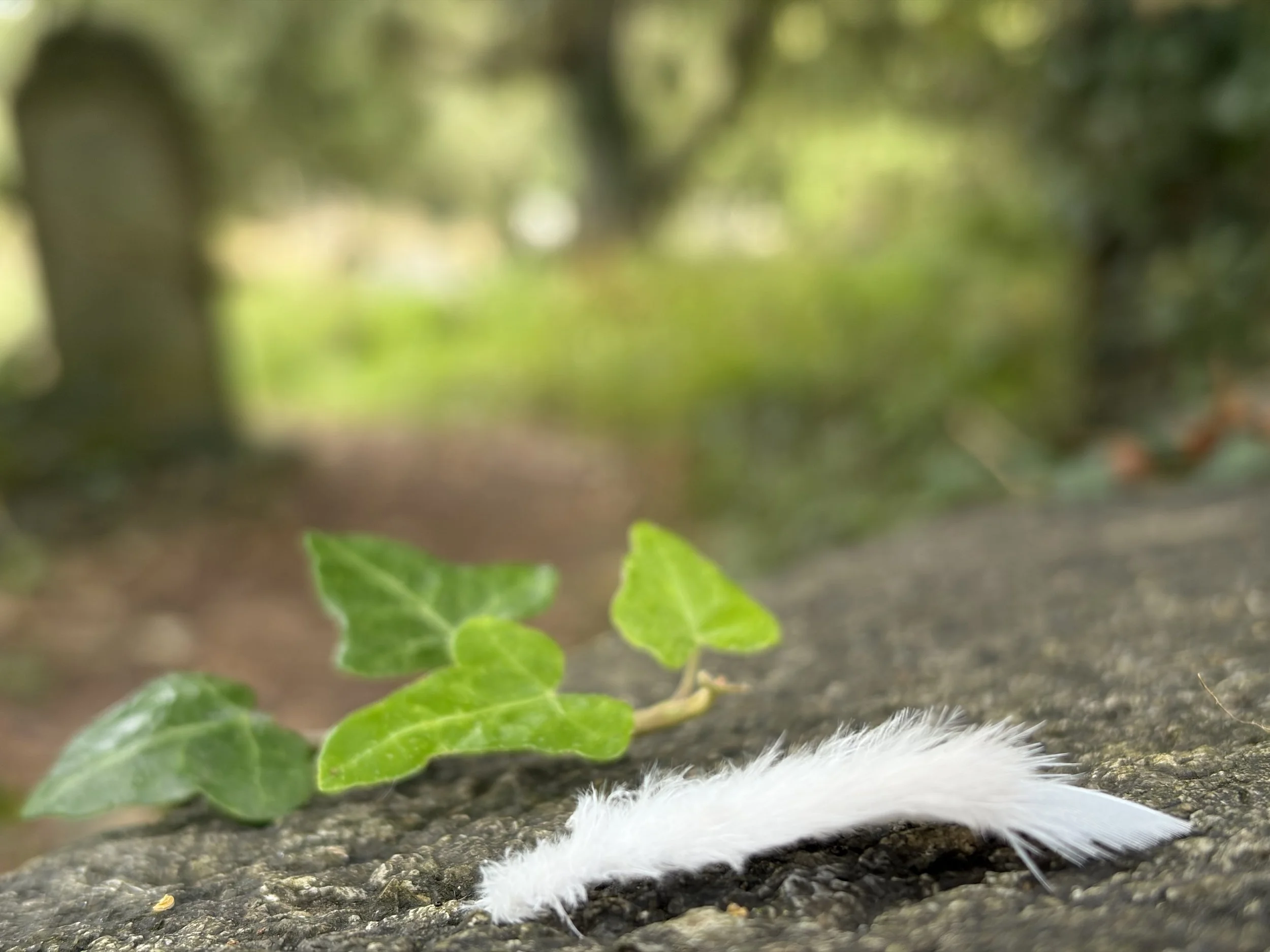
A small white feather resting on a box tomb in a church yard.
I was walking through a churchyard recently when I noticed a small white feather lying among the old headstones and box tombs. Its whiteness, softness and lightness stood out against the heavy weight and grey colour of the old stones. I found myself thinking about those who have gone before us and had a significant impact on our lives. They may no longer be here in physical presence, but the feather reminded me of the spiritual or emotional presence that can remain. When we leave this physical world, we pass things on to others: in the way we loved and encouraged them, in our ideas, and in the ways we lived that might have inspired another, perhaps giving someone the resilience to live through something very hard. The feather reminded me of the aliveness of the dead in the churchyard and of the ways they may continue to live in others and others in them.
Our ancestors are not only those whose blood runs in our veins. They can also be the people who have shaped, inspired, challenged or loved us, people who have helped us become who we are today. Their influence may have formed our values, our choices; they have become part our story and the way we show up in the our lives.
Across cultures, people have found ways to remember and honour the dead – we light candles, bring flowers, visit gravesides, prepare food and tell stories. These rituals help us acknowledge our grief and loss alongside our gratitude. They remind us that we belong to a story larger than ourselves and that somehow, these lives once lived are still speaking and living through us.
I want to also acknowledge that remembering isn’t about holding on to the past or pretending that every inheritance has been good. We can honour what has nourished us while acknowledging what has hurt us and we can begin to choose what we carry forward and what we leave behind.
As winter takes hold and the darkness closes in, I now keep noticing feathers on my walks. In some cultures, feathers signify a connection between the living and the dead or between this world and the spiritual realm. In these moments, it can feel as if someone is speaking from beyond the grave – perhaps they are, who knows, there is much we don’t understand in the mystery of life and death. But what I have learnt is that I am so appreciative of the friends who love and support me here now, AND I am also deep appreciative of those who lived before me and encourage and support me still. These people feel very alive to me, their lives seem to carry an eternal quality, one that crosses from Chronos, the time of clocks and calendars, into Kairos, the time of the sacred, where goodness and love is never lost.
We are approaching Samhain, the ancient Celtic festival often described as the Celtic New Year, marking the beginning of winter, from sunset on 31st October to sunset on 1 November. Alongside it come the Christian observances of All Hallows’ Eve (Halloween) on 31st October, All Saints’ Day on 1st November and All Souls’ Day on 2nd November, three days which share and overlap with older customs of remembering the dead. Culturally, this has long been a time to remember the ancestors, when the veil is thought to be thin between this world and the spiritual world.
So I offer a few contemplative questions to ponder:
Who do you carry in your heart and life from the past?
What have they given or passed on to you that brings you life today?
What might you want to pass on to those who come after you?
If this interests you, you can join the online retreat “Drawing on the Ancestors” live or get in touch to access the recording.